Part 1: Is This Really Happening to Me?
What is Abuse?
Abuse is when someone does or says things to gain control over another person by hurting that person or causing feelings such as fear, anxiety, nervousness, guilt, helplessness, or worthlessness. Abuse is done on purpose and is used to intimidate others. Abuse can occur in a variety of ways:
Physical abuse means using or threatening to use physical force. It could be actions like hitting, slapping, punching, pushing, grabbing, shaking, kicking, choking (strangulation), pulling hair, or burning you.
Emotional and verbal abuse involves the use of words and actions that attack how you feel about yourself or that make you feel unsafe. Emotionally abusive behaviour deliberately undermines your self-esteem and confidence. It could include put-downs, name-calling, swearing, yelling, blaming, shaming, or mocking you. They may threaten to harm you, themselves, children, or pets, or use silence and withdrawal as a means to control. They may stalk you or harass you with calls, emails, or text messages.
Emotional/Psychological abuse involves attacking the victim’s sense of self-worth through verbal abuse, humiliating or demeaning comments often in front of others, claiming the victim is crazy, isolating the victim from their family and friends, gaslighting**; threats of any kind including threats to children and pets.
What is gaslighting?
- Downplaying an abusive event, or denying that it happened
- Claiming the other person started it
- Purposely making someone seem disorganized, such as hiding their keys and claiming the other person lost them
- Alternating between supportive and critical behaviour to keep someone off-balance and confused
- Telling lies about their partner to make them seem unreliable to others, so that they many not be believed if they open up about the abuse
Social abuse includes isolating you from your social networks and trying to control where you go, what you do, and whom you see or talk to. It may include repeatedly cutting down your friends and family so that you slowly disconnect from your social supports. It can also be verbally or physically abusing you in front of others.
Financial abuse involves controlling money. It can include being denied access to money (even money you earn yourself), being given an “allowance” that doesn’t cover your or your family’s needs, or making you ask for money and explain everything you spend. “Borrowing” money and never paying it back, stealing, forging your signature, using your PIN number, or preventing you from working are all examples of financial abuse.
Sexual abuse is any unwanted sexual behaviour that you do not give your consent to. This includes touching, kissing, forced sexual contact, and rape. It might also be forcing you into sexual acts that cause pain, humiliation, or that take place while you are unconscious, asleep, or intoxicated.
Spiritual abuse impacts your spiritual, religious, or personal belief system, or uses beliefs to control you. This can mean using spiritual or religious teachings against you or justifying abuse and violence as “punishment” or “correction.” It could also mean forcing you to stop practicing your spiritual beliefs, “calling down” your belief system and the values and morals you live by, or forcing you or your children into a belief system that you do not choose.
Cyber abuse is behaviour that can take place in various online spaces, including chat rooms, social networking sites, emails, messaging apps, or message boards. It is behaviour that threatens to hurt you socially, psychologically, or even physically. Cyber abuse includes sending, posting, or sharing negative, harmful, false, or mean content about you. It can include sharing personal or private information about you, causing you embarrassment or humiliation.
Animal abuse is a form of abuse involving your pets and animals. The abuser may threaten to harm the animals if you leave or refuse to let you take them to the vet if needed. The abuser uses the animals as another way to manipulate and control you.
Who can be abused?
Anyone can be abused. Anyone can be abusive. Abuse does not discriminate. Abuse and violence can happen to anyone of any age, race, religion, sexual or gender identity, political or socio-economic background, employed or unemployed, people with disabilities or able-bodied people. They can be your neighbours, co-workers, family, or friends.
Abuse and violence can happen in any relationship. It can happen between:
- People who live together – married or common-law partners
- People in a dating relationship – romantic and intimate involvement
- People who were in a relationship but it has ended
- People in a care-giving relationship – a person and someone providing care for them, such as a senior or person with a disability receiving care from a family member, friend, or someone paid to provide care.
Abuse is never your fault.
People who experience abuse might have challenges and concerns that can make it difficult to seek help including:
- Assuming blame. You may believe it is your fault or feel you deserve the treatment you receive. You may feel responsible to make things better.
- Not being taken seriously. You may fear that you will not be believed or taken seriously if you ask for help.
- Dependency. You may be mentally, emotionally, or financially dependent on the abuser. In the situation of immigration, the abuser may be the person who sponsored you into the country. The idea of leaving the relationship creates significant feelings of depression or anxiety.
- Obligation. You might feel a sense of obligation to your relationship or to your family.
- Protecting children. You may be afraid to leave your children alone with your abuser. You may be afraid that the abuser will tell your children that you are a bad person or that you don’t love them. You worry that if you leave, you will never be allowed to see your children again.
- Feeling embarrassed/ashamed. You may feel ashamed at being involved with someone who is abusive. Maybe family members or friends pointed out some concerns they had about your partner or early in the relationship there were red flags that you dismissed. You may feel embarrassed to tell anyone about the abuse because you believe that it is shameful to talk about your relationship with other people.
- Access to information and services. If you are new to Canada, you may not be familiar with the laws here. Regardless of the laws in the country you came from, abuse is never acceptable in Canada. You might feel that you do not trust anyone enough to talk about what is happening. Maybe you feel that you do not know enough English to communicate so someone will understand or believe you. Your abuser might also scare you by telling you that you will lose your children if you leave the abuse. This is not true. If you have a disability, you may face challenges in finding services that are accessible to you. There are services available that can work with you online or over the phone to help you to find the supports that meet your needs.
Deciding to reach out for help is a big decision. There are people to help you to work through challenges and concerns that you may have. Reach out for help. Check Part 3: Finding Help for contact information.
What is the Cycle of Violence?
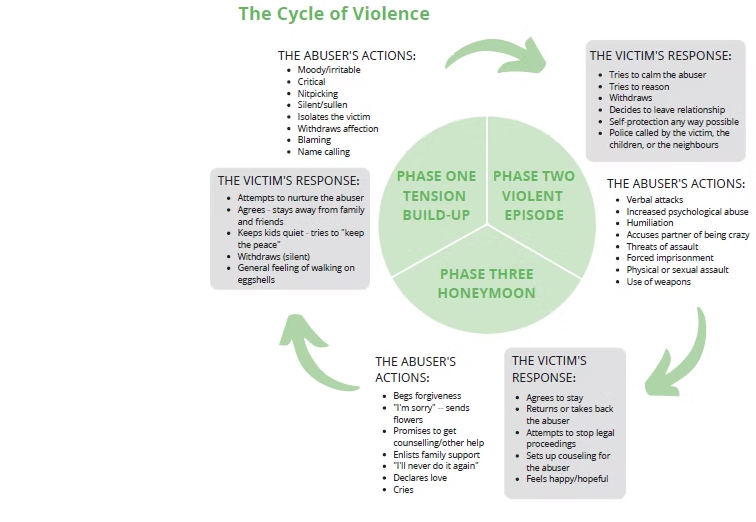
The “Cycle of Violence” is used to explain patterns of abusive behaviour. In some relationships, abuse does not start until years into the relationship; for others the abuse begins right away. The cycle of violence is common in abusive relationships. Depending on the relationship, the cycle might take hours, days, or months to repeat. Often, each time the cycle repeats itself, the violence gets worse.
Phase One - Tension Build-Up
The tension build-up phase can be described as “walking on eggshells.” You most likely feel stress and strain as you try to keep the peace in the relationship. The abuser seems increasingly angry and emotionally abusive. You might feel afraid and avoid disagreeing with them. An incident occurs that triggers a violent episode.
Phase Two - Violent Episode
The violent episode occurs when the abuser believes that they are losing control and tries to regain it by being abusive. During a violent episode, the abuser will lash out with the aim of hurting you physically and emotionally. You might feel afraid, hopeless, weak, and humiliated.
Phase Three - Honeymoon
After a violent episode has occurred, the abuser will make excuses for their actions, trying to downplay what happened. The abuser might blame you for not keeping the peace. The abuser might try to convince you that it was your fault, and that the violence occurred because of something you did. At times, you may even find that you are blaming yourself for the violence and abuse.
Often, the abuser may seem sorry for the abuse. They might promise that it will never happen again or promise to get help. The abuser will look for your forgiveness. Things will seem better and you may believe that the abuser has changed. However, the cycle repeats itself and soon you will find yourself in the tension phase once again. It is the honeymoon phase that gives you hope and promise that things will get better. This may be one of the many reasons why you remain in the relationship.
As time goes on, often the tension building and violent episodes increase in frequency and length, and the remorse/romance phase becomes shorter and shorter. However, not all abusive relationships experience this same cycle of violence or abuse. For some people, violence occurs at random without warning; for others it happens constantly.
Recognizing the signs
Recognizing abuse is the first step to making changes. Abuse often escalates from threats and verbal abuse to physical violence. While physical injury may be the most obvious danger, the emotional and psychological impacts of abuse are also severe. There are many signs of an abusive relationship. The most telling sign is that you are afraid of the other person. If you feel like you have to walk on eggshells around them – constantly watching what you say and do in order to avoid a blow-up – then your relationship could possibly be unhealthy and abusive. Other signs include the other person belittling you or trying to control you. You may experience feelings of helplessness and desperation.
There are many different behaviours that demonstrate that the other person wants to control you. Do they:
- Have a bad and unpredictable temper?
- Humiliate or yell at you?
- Ignore or put down your opinions or accomplishments?
- Threaten to take your children away or harm them?
- Threaten or damage things that are important to you?
- Threaten or harm your pets?
- Keep you from seeing your friends and family?
- Limit your access to the phone, money, or car?
- Try to control everything you do?
- Constantly text or message you to see where you are or who you are with and get angry when you don’t respond?
- Act excessively jealous or possessive?
- See you as property or a sex object rather than a person?
- Treat you so badly that you are embarrassed if your friends or family see?
Making Excuses
Sometimes you may make excuses or minimize what is happening. Have you ever said any of these things to yourself or someone else?
- It won’t happen again. They promised.
- They never hit me, and if I don’t have bruises or broken bones, then it can’t be abuse.
- It must have been a mistake and they were only trying to teach me to be better.
- They wouldn’t hurt me if they’d only stop drinking or using. It’s all because of the alcohol/drugs.
- They only have my best interests at heart. They really do love me.
- If I hadn’t said (or done, or not said, or not done) that, they wouldn’t have hit me (or yelled, or hid the car keys, or beat the dog).
- They are smarter than me so they should make the important decisions.
- It’s because they love me so much and can’t live without me that they say they will kill themselves if I leave.
- I am the only one who understands them.
- They won’t take my money again. They probably just needed it for something important.
Has the abuser ever said any of these things?
- I am sorry but…
- Quit making such a big deal out of it.
- It’s just a little scratch.
- What are you talking about? Nothing happened.
- If you hadn’t done this, I wouldn’t have hit you.
- Where do you think you’re going? You’re not leaving this house.
- I was tired.
- I was drunk/high.
- I’m under stress at work.
- The kids were making too much noise.
- You’re so crazy – no one will believe you.
- You make things hard for me because taking care of you is so much work.
How You Might Feel
Abuse wears down your body, mind, and spirit. The stress from the abuse affects your health and wellness. You may experience physical symptoms like headaches, stomach pains, diarrhea, heartburn, chest pains, and aching muscles. You may noticebreakouts and acne, increased allergies, or aching jaws from grinding or clenching your teeth. You may be restless, have problems sleeping, or have nightmares.
Your mental health and wellbeing can change. You may be depressed. You may feel overwhelmed with everyday life and be nervous, tense, anxious, and on edge most of the time. You may have difficulty thinking clearly and making decisions. You may feel “numb” and helpless, like you are not present in your own body. You may feel self-conscious and bad about yourself. You may be easily irritated or angered. You might have thoughts of suicide.
Coping with abuse is stressful. You may feel afraid of the abuser most of the time and avoid certain things because you are afraid of angering them. Perhaps you feel like you can’t do anything right. You may cry uncontrollably. You may have difficulty controlling your anger and lash out at people. You may find that behaviours like shopping, smoking, gambling, gaming, having unsafe sex, drinking, or using drugs are hard to control. You may overeat or eat too little and gain or lose a lot of weight. You might not care about what you look like and may lose interest in healthy sex. Nervous behaviours like biting your nails, pulling your hair, or not being able to be still may increase. You might harm yourself by cutting or hurting yourself in other ways. You might isolate yourself by avoiding friends and family, not returning calls or messages, or not wanting to go out in public. These behaviours and feelings are natural reactions to a stressful situation.
If you, or someone you know, is having thoughts of suicide, reach out for help. Go to the nearest emergency room, or call 911 or 811.
Is it Still Abuse If…
- There has not been any physical violence? YES! Many people are emotionally and verbally abused. This can be just as frightening and is often more confusing to understand.
- The abuse seems minor compared to what you have read about, seen on TV, or heard other people talk about? YES! There isn’t a “better” or “worse” form of abuse.
- Physical abuse has only occurred once or twice in the relationship? YES! Studies indicate that if the abuser has physically hurt you once, it is likely to happen again.
- The physical assaults stopped when you became passive and gave up your power and right to express yourself? YES! It is not a victory if you have to give up your rights as a person in exchange for not being abused.
Is this “Normal”?
Often people don’t realize that the situation they consider “normal” is actually abusive. If you grew up in a violent environment or have become used to living in an abusive relationship, you may think your situation is “normal.” It is not. Most times abuse does not start at the beginning of a relationship. It happens slowly, very subtly and over time. Because of this, the acts of violence can be explained away. The abuser comes up with many different reasons as to what went on, causing you to question your own perception of what took place. It’s “crazy making” behaviour.
Sometimes you might feel that the abuse is your fault. You are not responsible for the abuse. Everyone is responsible for their own behaviour. The abuse is NEVER your fault.
When you feel this way, you might make excuses for the abuser’s violence or justify the abuser’s behaviour.
Abusers are able to control their behaviour – they do it all the time. Abuse is intentional and purposeful.
- Abusers pick and choose whom to abuse. They don’t insult, threaten, or assault everyone in their life. Usually, they save their abuse for the people closest to them, the ones they claim to love.
- Abusers carefully choose when and where to abuse. They control themselves until no one else is around to see their abusive behaviour. They may act like everything is fine in public, but lash out instantly as soon as you’re alone.
- Abusers are able to stop their abusive behaviour when it benefits them. Most abusers are not out of control. In fact, they’re able to immediately stop their abusive behaviour when it’s to their advantage to do so, for example when the police show up or their boss calls.
- Violent abusers usually direct their blows where they won’t show. Rather than acting out in a mindless rage, many physically violent abusers carefully aim their kicks and punches where the bruises and marks won’t be visible.
Impact on children
Exposure to violence and abuse, including children witnessing, hearing, or being aware of violence by one adult figure against another adult, has potential to leave a child vulnerable and at risk of physical and emotional harm. If you are a parent who is experiencing violence and abuse, it can be difficult to know how to protect your child. When it is believed that a child has been exposed to violence and abuse and there is concern for the safety of the child, Child Protection Services in Saskatchewan may become involved with your family and be required to offer services for you and your child.